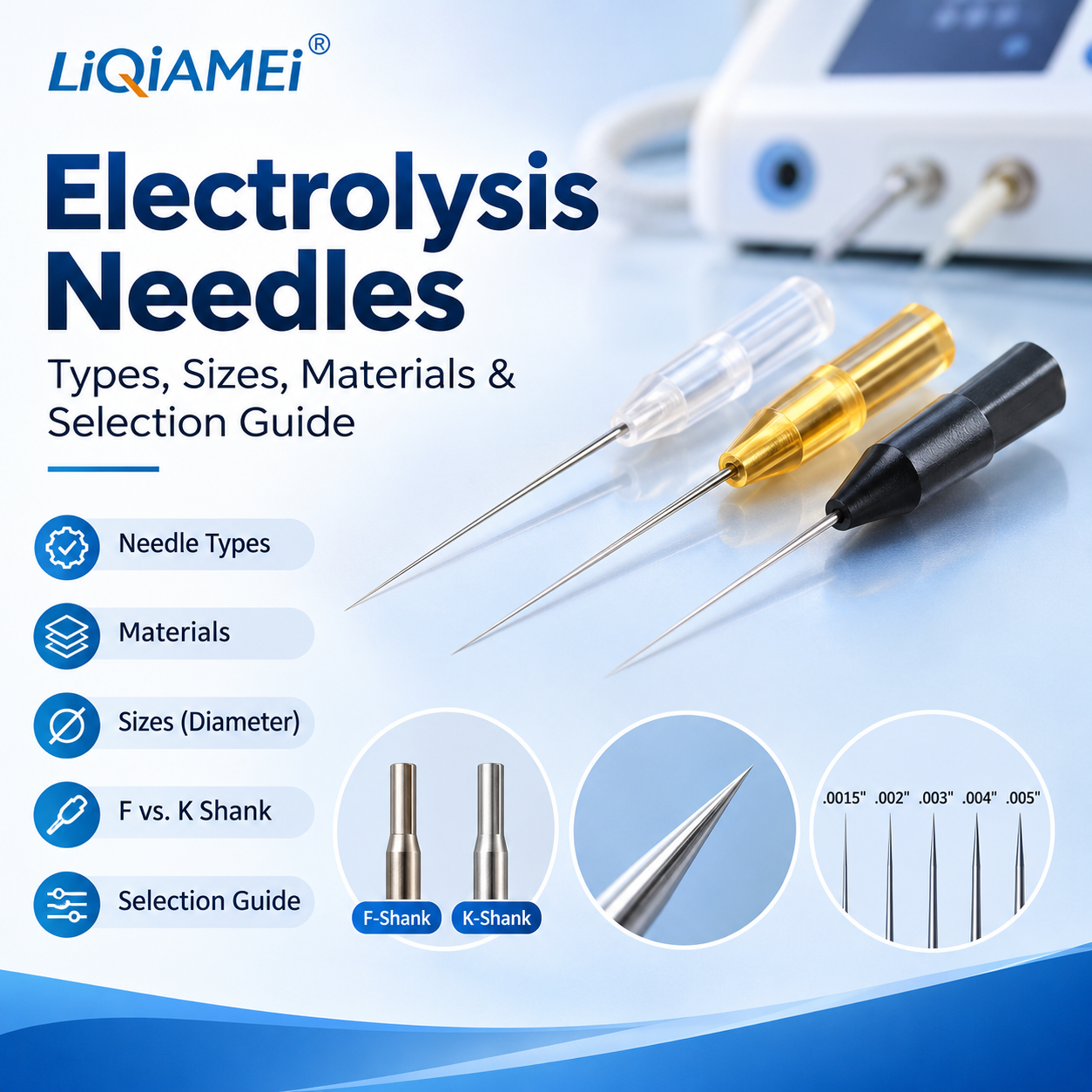
Electrolysis Needles: Types, Sizes, Materials & Selection Guide
PROFESSIONAL ELECTROLYSIS PROBE REFERENCE
Electrolysis Needles: Types, Sizes, Materials & Selection Guide
A practical guide to electrolysis needles and probes, including working-shaft diameters, F-shank and K-shank configurations, stainless steel and coated options, machine compatibility and essential buying considerations.
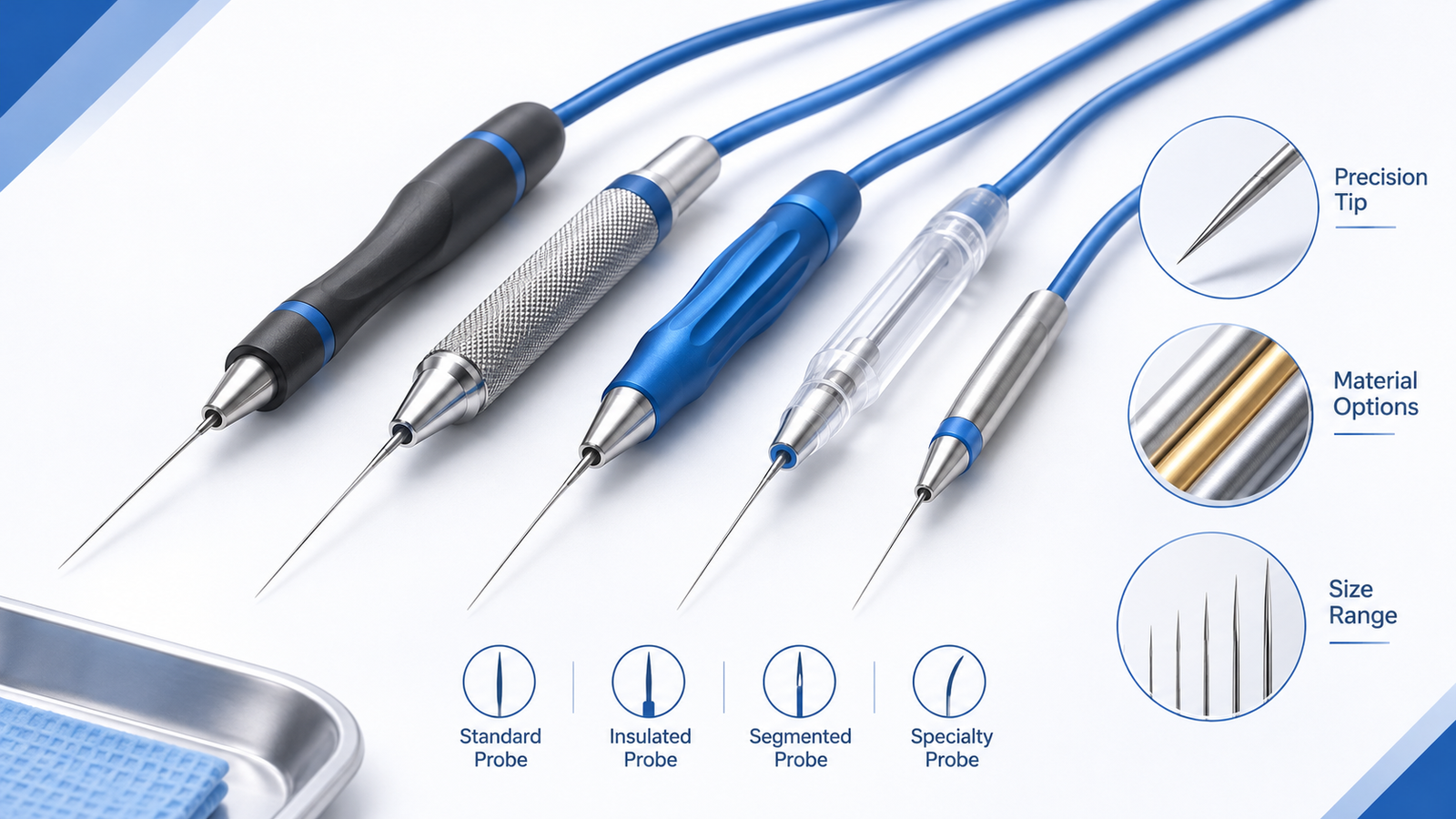
Electrolysis needles (also called electrolysis probes) are fine electrodes used during professional electrolysis hair removal. Probe selection depends on working-shaft diameter, probe-holder compatibility, material or coating, and the practitioner’s treatment technique. Common size labels include 2, 3, 4, 5 and 6; F-shank and K-shank refer to the thicker end of the probe that fits the holder, not the diameter of its working tip.
1. What are electrolysis needles?
An electrolysis needle is a slender, solid electrode used by an electrologist to deliver electrical energy within a hair follicle. In the professional electrology industry, the term probe is frequently preferred because the working end is designed for insertion along a follicle rather than for puncturing tissue in the manner of a sharp hypodermic injection needle.
Electrolysis treatment can use galvanic current, high-frequency thermolysis or a combination called the blend method. The probe is one component of a system that also includes the epilator, the probe holder and the practitioner’s technique. A high-quality probe cannot compensate for an unsuitable machine setting or an incorrect insertion.
Electrolysis needle vs. electrolysis probe
Searchers use both names for the same class of hair-removal electrodes. Product descriptions, educational resources and ordering documents should therefore identify the item clearly as an electrolysis probe (needle) where useful, rather than treating the words as two separate products.
This guide focuses on professional probes and product selection. It is not a guide to performing electrolysis on yourself or selecting treatment settings without professional training.
2. Electrolysis probe anatomy: tip, shaft and shank
Three physical features are important when comparing professional electrolysis needles. They have different jobs and should be measured or specified separately.
The working end that follows the follicular canal. Tip geometry and surface finish are relevant to the insertion experience.
The fine section of the probe. Its diameter is commonly expressed as a size number or a measurement in millimeters.
The thicker mounting portion held by the probe holder. Its dimensions determine whether the probe can be properly secured.
One-piece and multi-part designs
Probe construction can differ among manufacturers. Some designs are formed as a continuous metal component; others join a fine working shaft to a separate shank. Neither label alone proves that a product is better. For a meaningful comparison, examine the actual geometry, joint integrity where applicable, tip finish and documented quality requirements for the specific model.
For professional buyers, the most useful supplier question is not simply “one-piece or two-piece?” but “Can you provide a drawing or specification for the working shaft, tip and shank?”
3. Main types of electrolysis needles
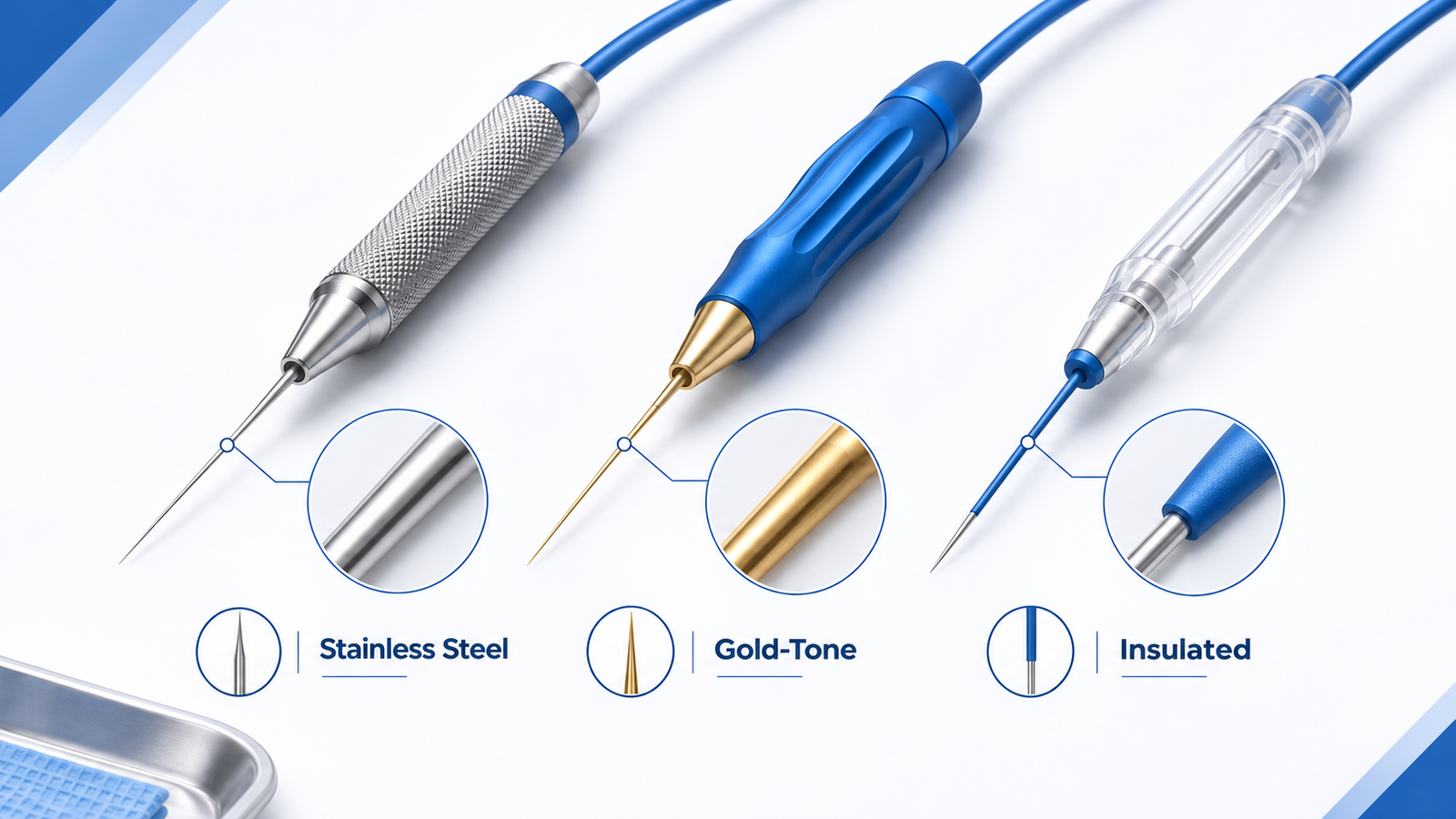
Electrolysis needles are often grouped into stainless steel, gold and insulated types. This is a useful shopping convention, but it combines different technical properties: base material, surface finish and electrical insulation. Those properties should be evaluated separately.
| Category | What it describes | What a buyer should verify |
|---|---|---|
| Stainless steel probe | A probe using stainless steel as its principal metal material. | Material specification, available diameters, shank configuration and packaging. |
| Gold-plated probe | A probe with a specified gold coating over another material. | Whether gold plating is actually present, coating details and supporting documents. |
| Gold-tone probe | A gold-colored surface appearance; the name alone does not establish gold content. | Actual surface-treatment chemistry and product designation. |
| Insulated probe | A probe with an electrically insulating coating on part of the shaft. | Insulated area, exposed working region, coating integrity and compatible use. |
A product may use stainless steel as its core material and still have an additional coating. Comparing only the category name can hide important differences between two suppliers’ products.
4. Electrolysis needle sizes and diameter chart
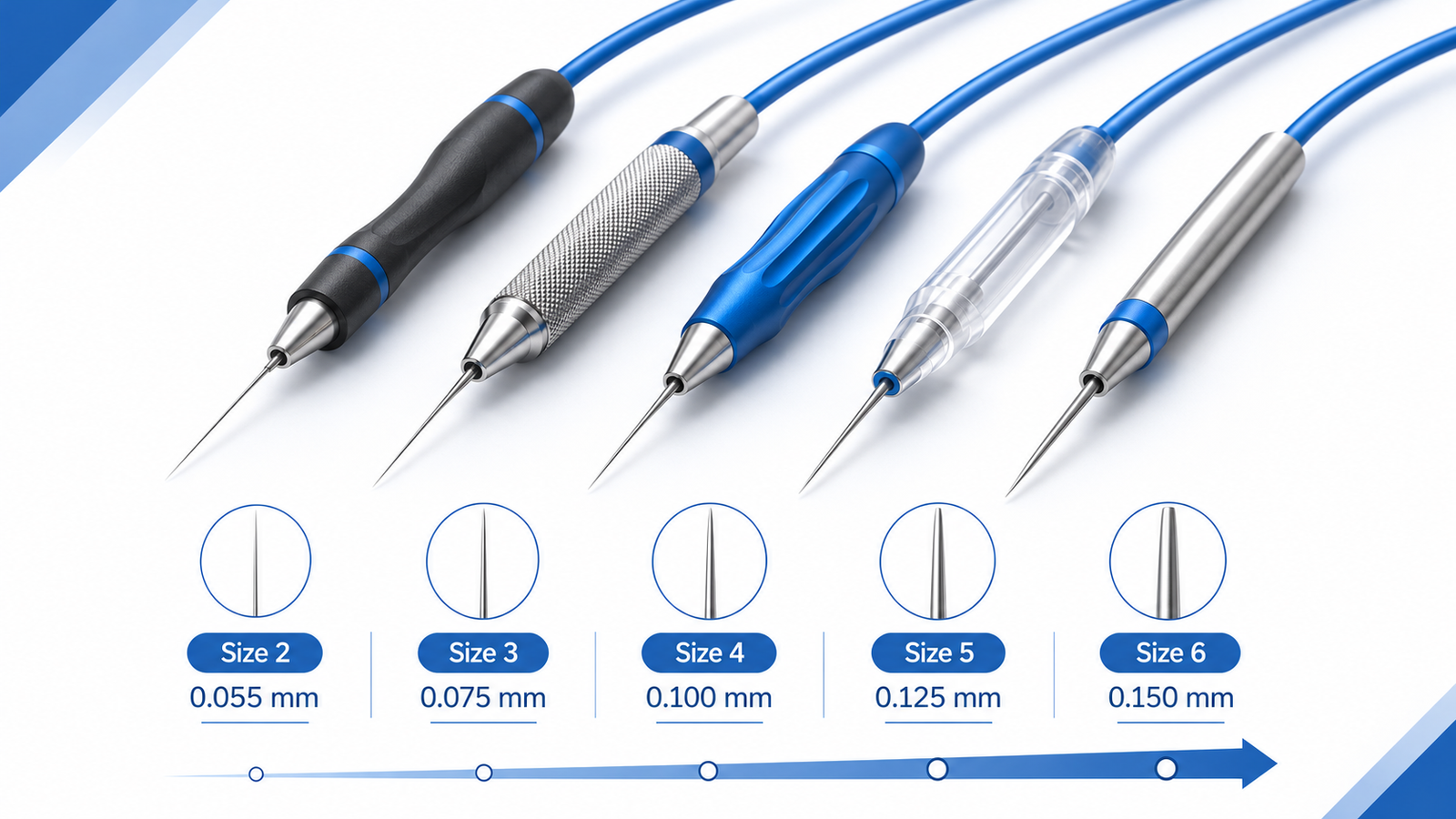
Electrolysis needle size generally describes the thin working portion of the probe. Size labels such as 2, 3 and 4 are commonly used in professional catalogues, but they should not be confused with ordinary injection-needle gauge systems. When comparing suppliers, use the actual diameter in millimeters (mm) as your reference.
The following sizes have been listed for LiQiAMEi's stainless steel and gold-tone electrolysis probe series. Buyers should confirm current availability and the specification for the exact model being ordered.
| Nominal size | Working shaft diameter | F-shank model | K-shank model |
|---|---|---|---|
| Size 2 | 0.055 mm | F2 | K2 |
| Size 3 | 0.075 mm | F3 | K3 |
| Size 4 | 0.100 mm | F4 | K4 |
| Size 5 | 0.125 mm | F5 | K5 |
| Size 6 | 0.150 mm | F6 | K6 |
These are working-shaft diameters, not shank diameters. This table does not establish the size range of LiQiAMEi's insulated series. Actual product availability and tolerance specifications should be confirmed before ordering.
How do electrologists select the diameter?
As a broad professional reference, finer hairs call for finer probes, while larger terminal hairs may call for a larger working diameter. However, the correct choice also depends on follicle characteristics, technique and the practitioner’s assessment. It is not reliable to assign one fixed probe size to every client or body area.
For technical comparison, ask for a diameter specification in millimeters and, for high-volume procurement, any relevant dimensional tolerance or inspection method available from the supplier.
5. F-shank vs. K-shank electrolysis needles
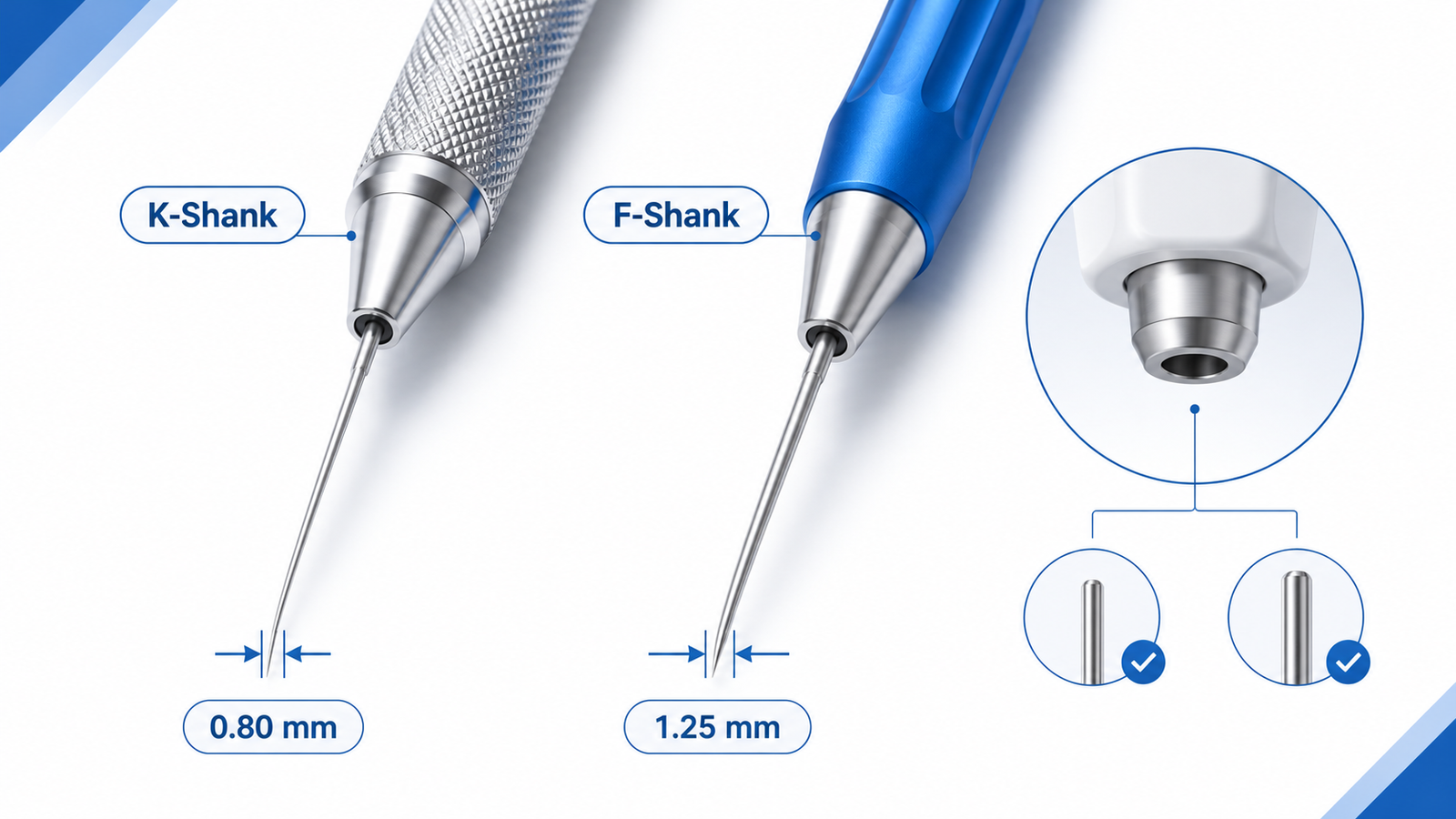
F-shank and K-shank refer to the mounting end of an electrolysis probe. They are used to match the probe to a compatible holder. The distinction is independent of the thin working-shaft diameter: for example, F3 and K3 can have the same nominal working diameter while using different mounting-shank dimensions.
| Shank type | Common nominal diameter | Check before ordering |
|---|---|---|
| F-shank | 1.25 mm | Confirm probe-holder bore, grip and recommended probe type. |
| K-shank | 0.80 mm | Confirm probe-holder bore, grip and recommended probe type. |
These are widely published industry reference dimensions (see the Ballet practitioner guide in the references). They do not replace the technical drawing or dimensional confirmation for an individual LiQiAMEi production model.
Does an F-shank probe fit a K-shank holder?
Do not assume the two formats are interchangeable. A nominally incorrect shank may fail to seat securely or provide the intended electrical contact. Confirm the holder requirements with the epilator or probe-holder manufacturer and compare them with the exact probe dimensions.
If you are sourcing electrolysis probes for a clinic or distribution business, record both the working size and shank type in each SKU. “Size 3” by itself is not a complete compatibility specification.
6. Probe materials, finishes and insulation explained
Stainless steel electrolysis probes
Stainless steel is a common base material for professional electrolysis probes. When evaluating stainless steel options, verify the supplier’s stated material specification rather than assuming that all products described as “medical grade” use the same alloy, surface finish or production process. Product suitability for an individual client must still be judged by the practitioner.
Gold-tone vs. gold-plated electrolysis needles
Gold-plated means a gold coating is present. Gold-tone describes an appearance and does not, by itself, identify the coating as gold. These terms should not be used interchangeably in product catalogues, specifications or quotations.
LiQiAMEi has a product line described as Gold-Tone Electrolysis Probes. Buyers seeking a specific precious-metal finish should ask for the exact material and surface-treatment specification rather than inferring it from the product color. Claims about allergies, conductivity or clinical outcomes should be supported by information relevant to the actual product and treatment context.
Insulated electrolysis needles
Insulated probes have an electrically nonconductive layer over part of the shaft, leaving a defined region available for energy delivery. The location and properties of the insulation can matter to its intended use. Different manufacturers may use different coating designs; do not assume all insulated probes have identical exposed-tip lengths or performance.
Before purchasing, confirm the exact probe size, shank type, insulation coverage, packaging and manufacturer instructions. The presence of an insulating coating does not eliminate the need for trained technique or appropriate machine settings.
7. How to choose the right electrolysis needle
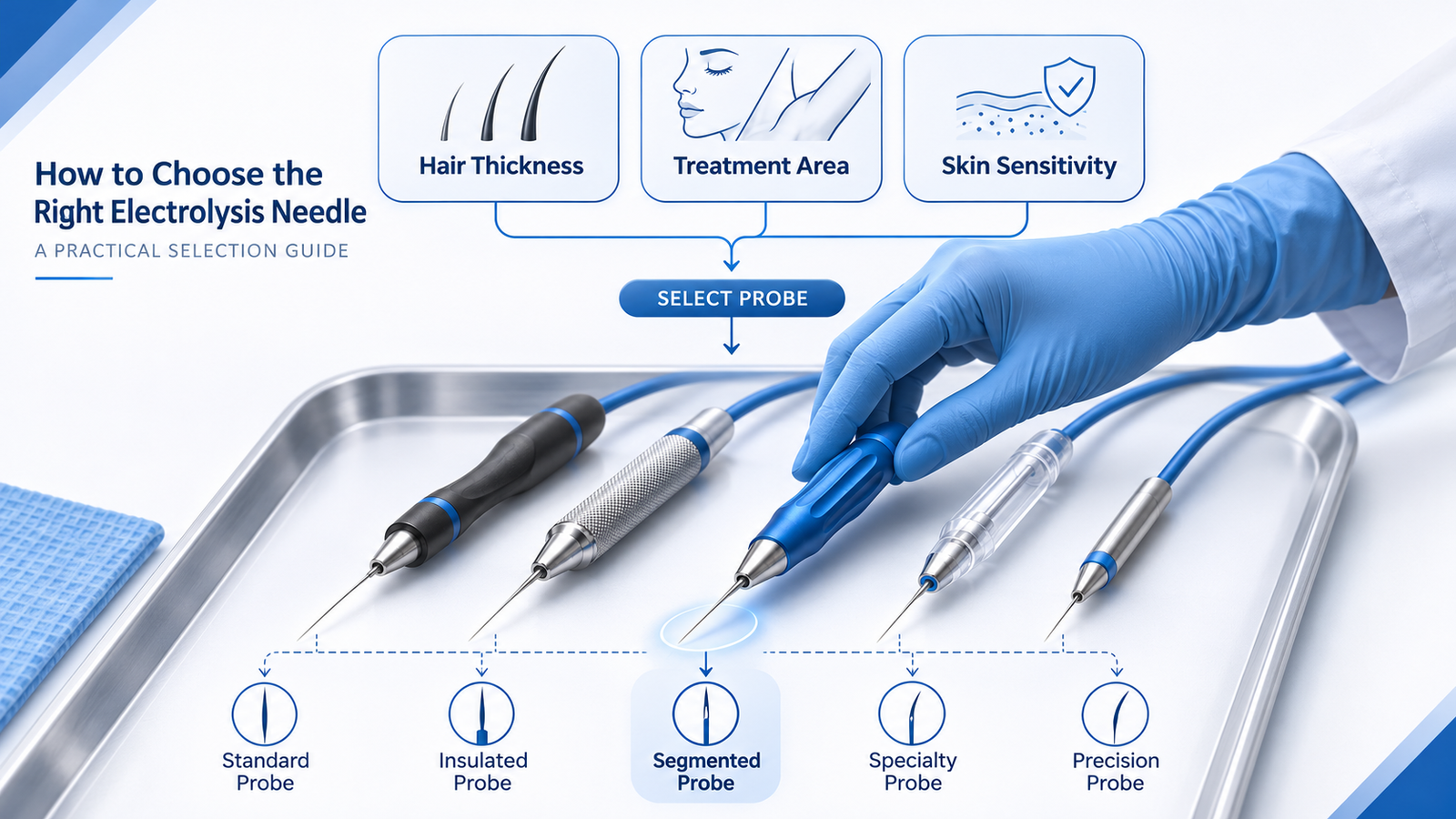
Rather than choosing by color or price alone, professional buyers can use the following sequence to compare electrolysis needle specifications systematically.
- Identify the working diameter. Review the hair and follicle characteristics with a qualified electrologist and select from the sizes supported by the practitioner’s technique and product instructions.
- Match the probe holder. Check whether the equipment accepts F-shank, K-shank or another documented format. Confirm the nominal diameter and holder requirements.
- Specify the material and finish. Separate the metal substrate from optional surface finishes. Do not equate gold-tone appearance with verified gold plating.
- Review insulation requirements. Where an insulated design is relevant, verify its product-specific coating and intended use rather than assuming equivalence across brands.
- Check packaging and use instructions. Confirm how the probes are supplied, whether sterility claims are documented, and how they are intended to be handled and discarded.
- Finalize the order specification. Record the size, shank type, material/finish, package configuration and quantity, and obtain confirmation of any additional documentation needed for your market.
For a distributor, a clear specification sheet helps reduce ordering errors across different machine holders and regional markets. For a clinic, an organized selection of compatible probe sizes can make stock management more predictable.
8. Electrolysis probe and machine compatibility
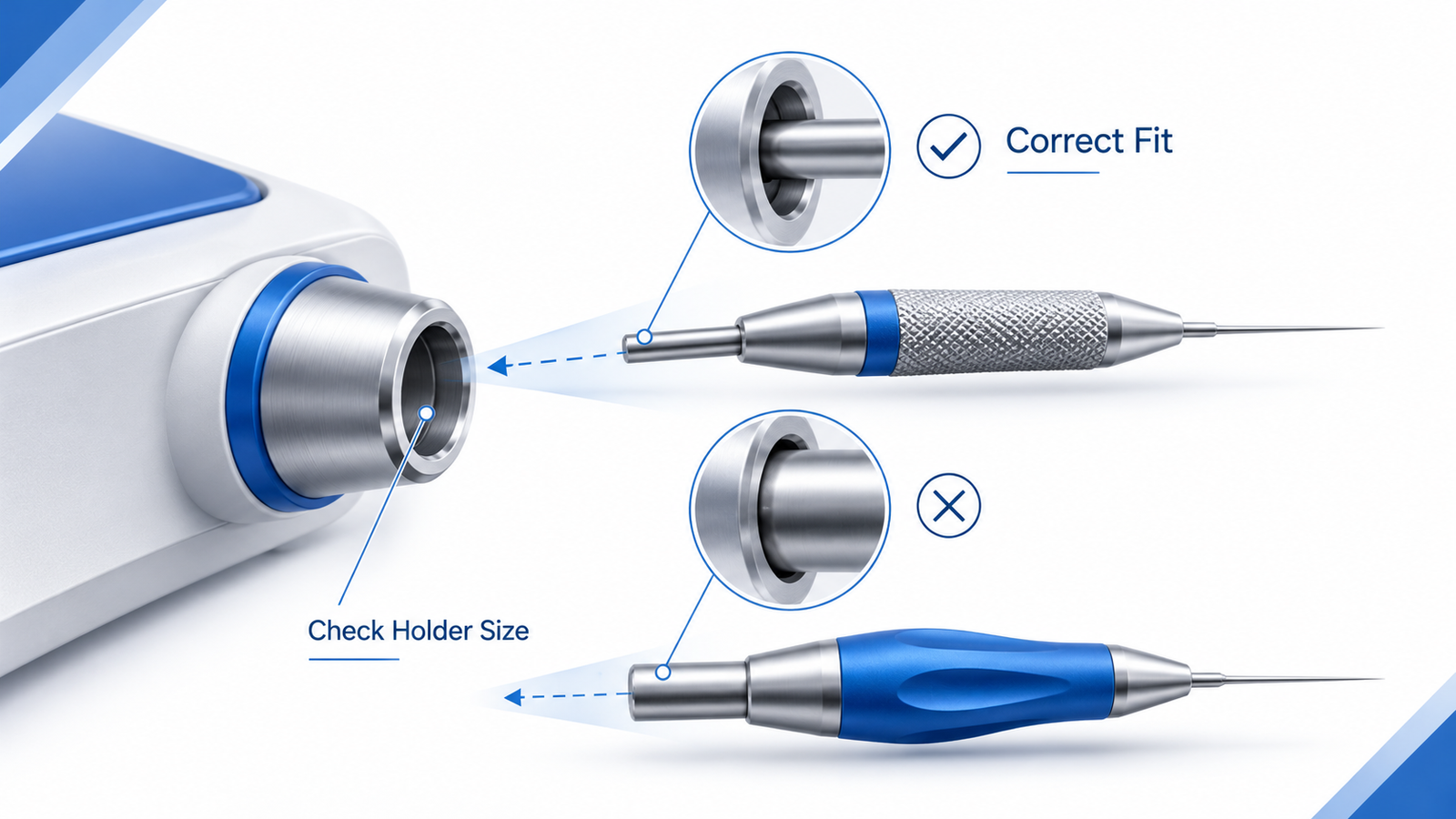
Not every electrolysis needle fits every epilator. Compatibility is determined primarily by the probe holder, its mechanical mounting dimensions and the relevant manufacturer instructions. A probe that looks similar to another model should not be treated as interchangeable without verification.
Compatibility checklist for buyers
- Exact make and model of the epilator or probe holder
- Required F-shank, K-shank or alternative holder configuration
- Nominal mounting-shank diameter and relevant fit requirements
- Selected working-shaft diameter or size number
- Manufacturer instructions regarding compatible probes and methods
LiQiAMEi customers can include these details when contacting the supplier. Compatibility should be confirmed for the exact combination; an unverified list of familiar machine brands can mislead buyers.
9. How electrolysis methods affect probe selection
Professional electrolysis is commonly described using three methods. Their energy-delivery principles differ, so probe selection and treatment settings should follow the practitioner’s training and the equipment instructions.
| Method | Basic principle | Probe selection consideration |
|---|---|---|
| Galvanic | Direct current produces an electrochemical action within the follicle. | Confirm material, product compatibility and instructions for the selected device. |
| Thermolysis | High-frequency alternating current produces localized heating. | Working diameter and insulation design may be relevant to the trained practitioner’s approach. |
| Blend | Combines galvanic and high-frequency energy. | Confirm the device and probe instructions for combined-method use. |
For an overview of electrolysis technology beyond probe specifications, visit the LiQiAMEi educational resources. This article does not provide electrical treatment parameters or instructions for unsupervised use.
10. Sterility, single-use handling and probe quality
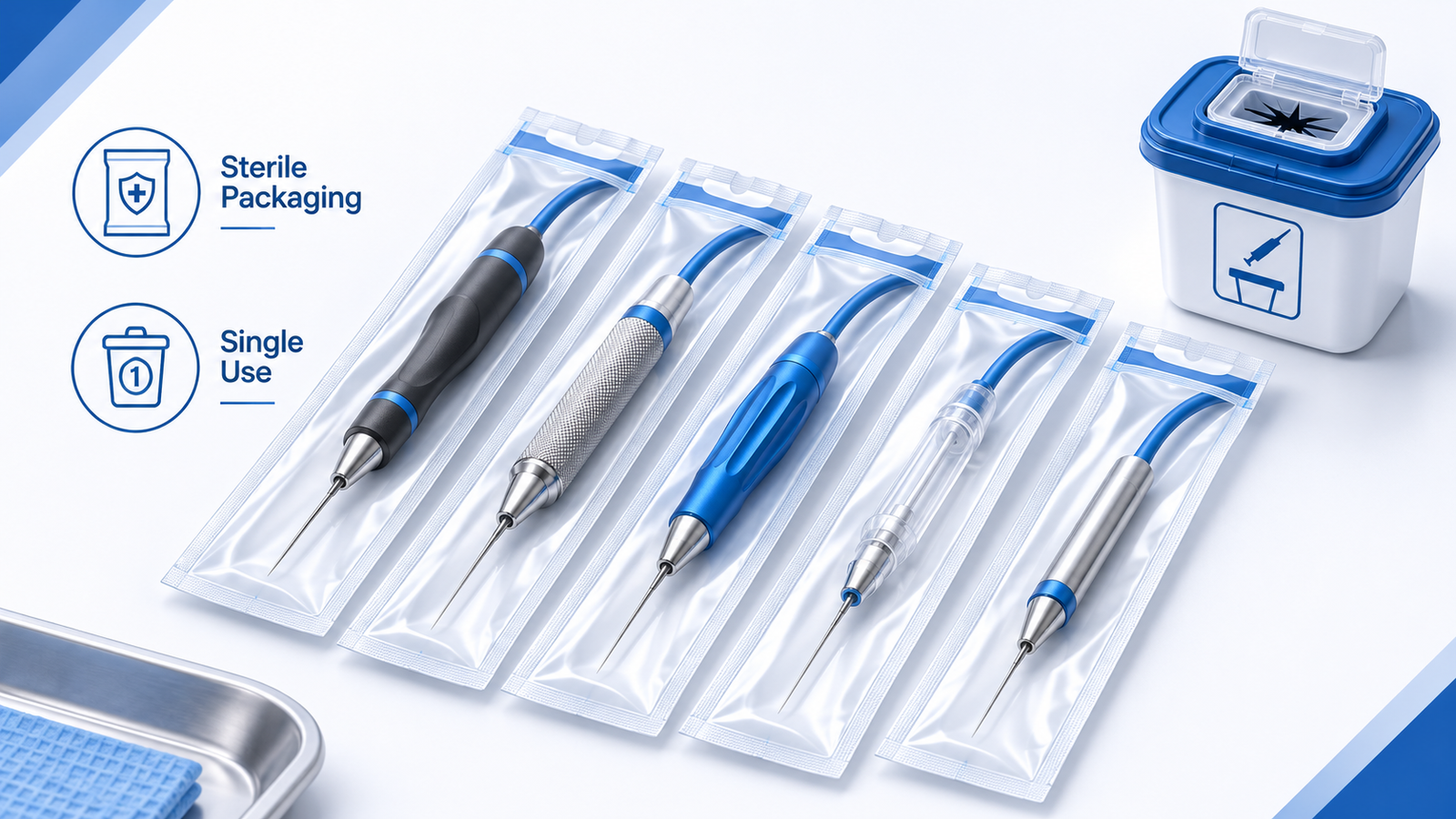
Infection prevention is a fundamental part of professional electrology. The American Electrology Association’s infection prevention standards call for pre-sterilized, disposable, single-use needles. A professional buyer should examine the applicable product labeling and documentation before making a claim that a particular supplied product is sterile or meets a named regulatory requirement.
Packaging and handling checks
- Inspect the package for visible damage and confirm the relevant labeling.
- Follow the device instructions and the applicable infection-control protocol.
- Do not reuse a product labeled for single use; discard used sharps in an appropriate sharps container according to local requirements.
- Confirm any stated sterilization method, batch traceability, expiry information and compliance documents with the supplier when applicable.
What professional buyers can request from a supplier

Depending on the product and intended market, useful technical information can include shaft and shank dimensions, material specification, surface-treatment details, packaging configuration, lot identification and applicable verification documents. Request evidence rather than relying on broad phrases such as “medical grade,” “hypoallergenic” or “certified” without supporting documentation.
Safety note: The information above is a purchasing reference, not a substitute for a qualified electrologist’s training, a device’s instructions for use, or local infection-prevention requirements. Regulatory classifications and documentation requirements vary by jurisdiction.
11. LiQiAMEi electrolysis needle product options
LiQiAMEi offers electrolysis probe categories for buyers comparing professional consumables. The series below should be selected by their actual published specifications, not only their appearance or category name. Contact the supplier to confirm current models, packaging and procurement details before placing an order.
Stainless Steel Electrolysis Probes
Review stainless steel series options, published working diameters and available F/K configurations.
View stainless steel probesGold-Tone Electrolysis Probes
Compare the gold-tone product line. Ask for the actual finish specification where coating composition is important.
View gold-tone probesInsulated Electrolysis Probes
Explore insulated products and request confirmation of model-specific diameters, shanks and coating details.
View insulated probesInformation to include in a B2B enquiry
To make a product enquiry easier to answer, include the desired probe series, working diameter or size, F/K shank type, estimated order quantity, destination market and any documentation you need to review. The supplier can then confirm which listed configurations are currently available.
12. Frequently asked questions about electrolysis needles
Are electrolysis needles and electrolysis probes the same thing?
In professional hair-removal product searches, the terms are commonly used interchangeably. “Probe” more clearly distinguishes the solid follicular electrode from a sharp, hollow injection needle.
What are the common electrolysis needle sizes?
Size labels 2 through 6 are commonly listed. In the LiQiAMEi stainless steel and gold-tone size reference above, the working diameters range from 0.055 mm to 0.150 mm. Always compare the actual dimensions for the model you intend to order.
What is the difference between F-shank and K-shank?
They describe probe mounting formats. Common reference shank diameters are 1.25 mm for F-shank and 0.80 mm for K-shank. Verify the exact holder and probe dimensions before use.
Is a gold-tone electrolysis needle gold-plated?
Not necessarily. “Gold-tone” refers to appearance and does not verify gold content. Ask the supplier for the actual coating or surface-treatment specification.
Are insulated electrolysis probes suitable for every technique?
No universal suitability should be assumed. The insulation design, device, treatment method and manufacturer instructions must be considered by a qualified practitioner.
Can I use the same electrolysis needle with any machine?
No. Probe-holder compatibility depends on mounting dimensions and the equipment manufacturer’s requirements. Confirm the exact F/K or other configuration before ordering.
What should a distributor check when buying electrolysis probes in bulk?
Verify the SKU configuration, dimensions, material and finish, packaging, lot identification, relevant product documentation, and market-specific requirements. Request a formal specification rather than relying on generic catalogue descriptions.
Need help selecting electrolysis probes?
Send LiQiAMEi your required sizes, shank configuration and purchasing requirements. Our team can review the available product information with you.
Contact LiQiAMEi